Understand how things work
My curiosity about technology began long before I knew what the pieces I had in my hands were called. When he was five or six years old, he was already disassembling toys to discover what they were hiding inside. I wanted to understand how a motor managed to move a doll or what made an object seem to come to life. My sisters got angry when one of their dancing dolls disappeared among my experiments, and with good reason: I was still learning to distinguish between opening something out of curiosity and being able to put it back as it was.
My first experiments with radio
The radios had me especially captivated. He dreamed of reaching distant signs and hearing what was happening beyond what he could see. Maybe I had imagined it from a movie or cartoon, but that idea led me to build my own version of a satellite dish: an umbrella covered with aluminum foil and a cable that connected to the inside of the radio.
I could spend hours on the terrace, moving that invention and trying to tune into a signal on medium wave and long wave, MW and LW. He adjusted the dial as precisely as he could and listened through the noise, hoping to find something new. Sometimes I even climbed onto a roof to try from higher up, without assessing the risk it entailed as I would today. In my head, every small change could bring me closer to a signal that I had not yet managed to hear.
Later they gave me a radio with a CB tuner, and that expanded my fascination with communications. I entertained myself for hours searching for conversations and listening to how other people used the radio to communicate. I was also drawn to the world of aircraft communications. The possibility of finding voices and messages traveling through the air seemed extraordinary to me.
From disassembling toys to repairing devices
Over the years, that custom of disassembling changed. It was no longer just about discovering what was inside: I was beginning to understand what could be wrong and how to fix it. Opening a device that didn't work became a challenge. You had to observe, test and be patient until you found the cause of the problem.
My father had a bar with two televisions, something that seemed unusual to me at the time. I was in charge of tuning and programming the channels, and he let me prepare the antenna connectors with coaxial cable. They were small tasks, but for me they represented an opportunity to participate and verify that what I was learning also served to solve real needs. I have very nice memories of that trust and those first jobs between cables and devices.
A room between music and electronics
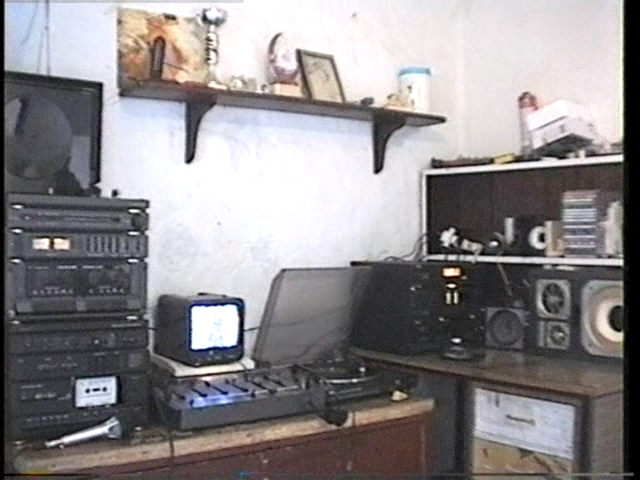
By the time I was sixteen, my room had become a kind of small laboratory. It had a window that overlooked the patio, a mini-system and a mixing board gathered together in a piece of furniture that, seen with my eyes at that time, looked like the command post of a spaceship. Music already had an important place in my life and I liked to surround myself with equipment that I could experiment with.
He had connected a small black and white television to that set. I remember watching the German music channel VIVA through the cable television that Tecamesa offered in Mahón. Between music, images and devices I was finding new ways to entertain myself and learn. I didn't follow a training plan: one idea led to another and each test opened the next question.
I even connected a potentiometer to the motor of the mini-system cassettes to vary the playback speed. I was interested in hearing how the music changed and discovering how much I could modify the operation of equipment that I already knew. Those experiments mixed electronics, sound and a curiosity that was rarely satisfied with using a device as it came from the factory.
The camera I wanted to take everywhere
The moving image came with a small video camera that my parents bought and that, in a short time, I ended up using constantly. When we traveled I wanted to record everything. I liked to save what I saw, follow the moments and return to the images later. The camera became another tool for exploration, this time looking outwards rather than into a device.
Maybe that's where everything began to come together: the interest in understanding electronics, the fascination with communications, music and the desire to film. I didn't know then that these hobbies would end up meeting in the same professional path. They were just the things I spent hours on because I enjoyed doing them.
Electrical training and first jobs
After finishing my studies I trained to work as an electrician. That preparation allowed me to move from experiments at home to a job, with real facilities and the responsibility of doing work that other people were going to use. At the end of the training, I entered into an internship at Andreu Roselló's electrical installations company, where I spent a few months learning alongside professionals.
Then I found a job as a maintenance technician at Blau de Menorca. It was an opportunity to apply what I learned and face different problems every day. Maintenance brought me closer to a part of the job that has always interested me: understanding an installation, locating what is wrong, and finding a way to get it back to working order.
From setting up facilities to maintaining them
Later I returned to the electrical installations with Centro de Montajes, the company in charge of these works during the construction of Insotel Club Punta Prima. With my colleagues we assembled the electrical panels that connected the apartments in each block. Participating in that work allowed me to see first-hand how the facilities were organized and to follow their assembly from within.
That knowledge opened up the possibility for me to stay as a maintenance technician in the hotel itself, in the Alonso Marí group of companies. I went from working on the facility during construction to dealing with it while the facility was up and running. It was a very valuable continuity: he knew the equipment and the circuits because he had participated in their assembly.
Those first jobs were the basis of my professional experience before reaching Madisa. Electricity and maintenance taught me to work methodically, check connections and look for the cause of a breakdown. At Madisa I would expand that experience towards computing, management programs and communications.
Learn on the job and continue researching
My learning combines this initial training, experience with colleagues and courses linked to my jobs with many hours of testing on my own. Much of what I know about computing, electronics and communications I have learned by trying to solve problems, making mistakes and trying again. Later I followed that same path with photography, flight systems, programming and artificial intelligence.
Today I continue to recognize that same way of learning when I prepare a photographic session, configure a flight system or experiment with an audiovisual process. Facing a real problem forces me to observe what happens, adjust, and try again. The tools change, but the restlessness of that child who wanted to discover how things worked remains.
«I trained to work as an electrician and I learned a lot in my first jobs. Afterwards I continued expanding my knowledge through tests, errors and problems that I wanted to solve. "I have always liked to understand what I have in my hands."Gustavo TaboadaReturn to tour ↑