From paper to wireless commands: five years in Madisa
After my first jobs in electricity and maintenance, I worked for five years in the IT division of Mallorca Distribución S. A., Madisa. It was a decisive stage in learning to connect electronics, software and people's needs. We assembled computers, prepared installations and resolved breakdowns, but we also accompanied a profound change in the way restaurants, bars and businesses in Menorca worked.
We collaborated with Ictinium, a company from Granollers that developed a pioneering touch point-of-sale terminal system. For those who came from the traditional cash register, this meant moving to a tool capable of coordinating sales, tables, orders and stock. The historical website of Ictinium highlighted the recognitions obtained in international competitions and presented the system as an evolution of cash registers.
Assemble, configure and connect
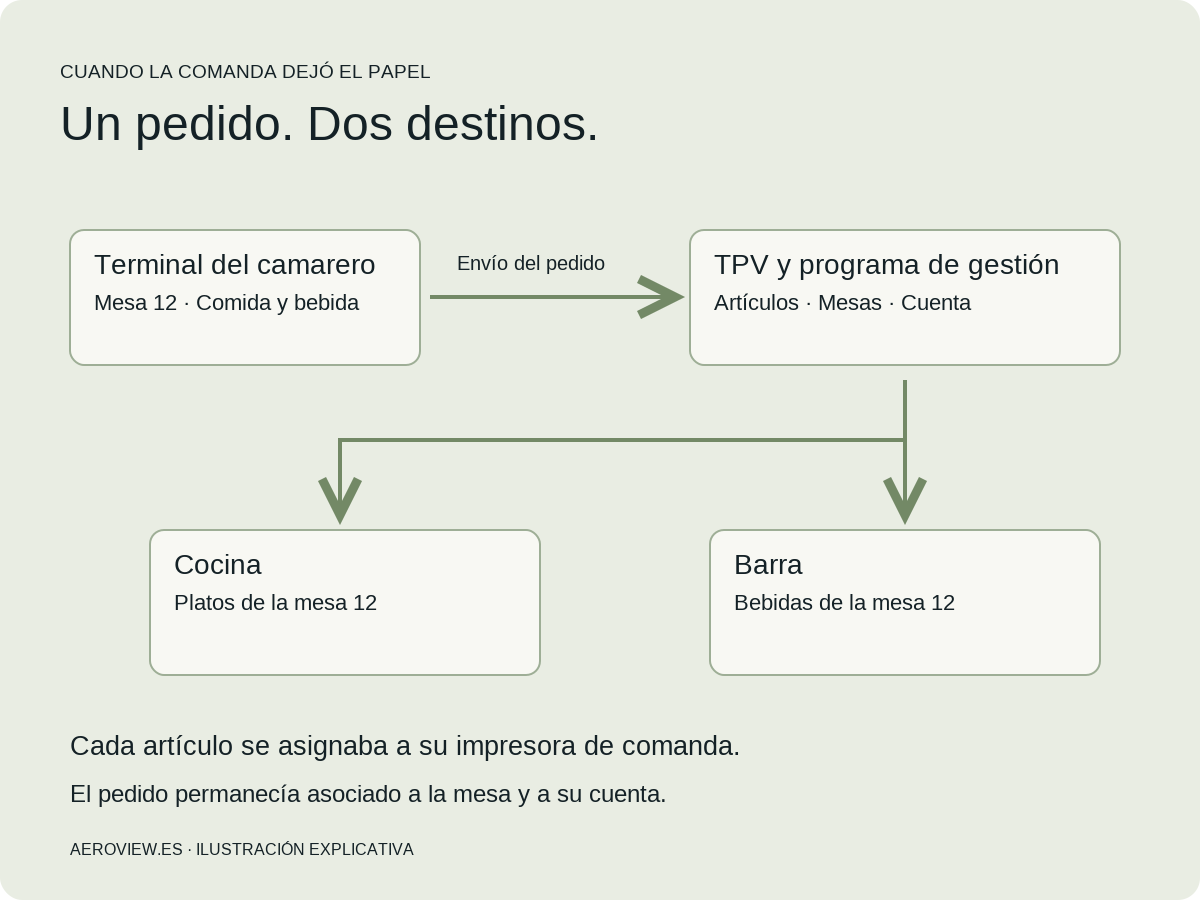
Our work began long before turning on the equipment in the restaurant. The computer had to be prepared and the program configured according to the menu and organization of each location: product families, prices, tables, permissions and printing destinations. Every item had to get to the right place. A meal could generate an order on the kitchen printer and a drink on the bar printer, even if both belonged to the order of the same table.
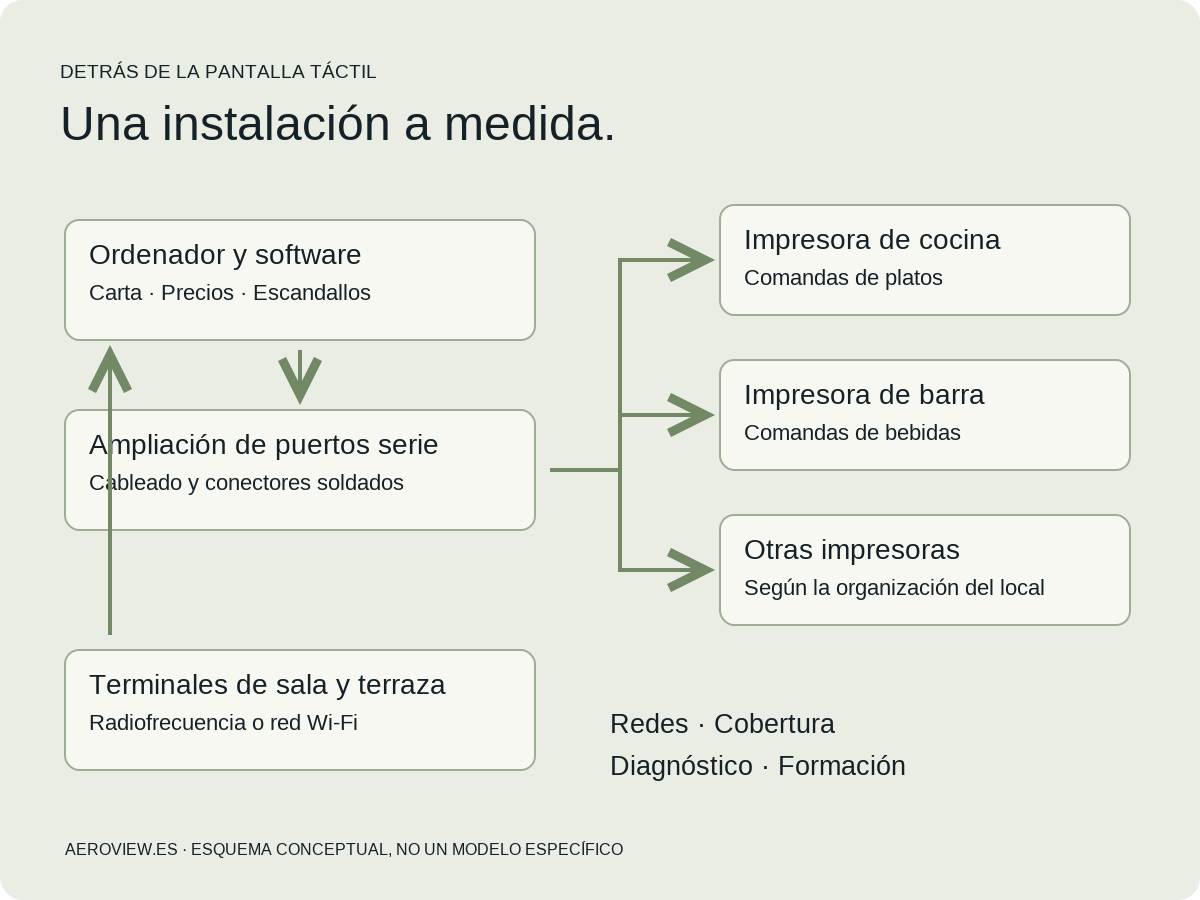
The waiter stopped having to go around the restaurant handing out paper notes. When entering the order into the terminal, the system distributed the information among the preparation stations and maintained the account associated with the table. We also installed screens in areas such as the terraces: from there the items and tables were introduced, the orders appeared at the bar station and the orders were sent to the corresponding printers.
Getting all of that to work required quite a bit of hardware work. In certain installations we had to connect more than five printers to a computer. We used serial port expansion cards connected to the motherboard, prepared the wiring and assembled the necessary connectors. Soldering, checking contacts, identifying a poorly connected pin or checking a power supply were part of the same work as configuring the program.
From infrared to radio frequency and PDAs
I experienced the transition between different generations of waiter managers. Some of the previous ones used infrared and required the device to be oriented towards a receiver to transmit the command. With radio frequency systems and, later, with Wi-Fi networks, this dependence on pointing at a specific point gave way to a more flexible way of working. Each technology had its own coverage conditions and installation problems.
I worked with WaiterMate and Orderman equipment, the latter a firm of Austrian origin. Monochrome screen touch terminals coexisted with the arrival of PDAs with Windows CE. Carrying a small computer in your hand, with a color screen and buttons organized by categories and colors, was then an important novelty. The interface could be adapted to the menu and the way of working of each establishment.
Thanks to Madisa I carried out the first installations of these systems on the island. Being able to work with those solutions when they were still new in Menorca opened up a field of research for me: wireless networks, coverage, antennas, interference and communication between devices. Each installation required observing how the information circulated and verifying that it arrived at its destination without errors.
Existences, scandals and training in Malaga
The program went far beyond charging. It made it possible to manage stocks and define the ingredients of each dish using scales: how much tomato, lettuce, onion or any other product corresponded to a preparation. Based on the sales and recorded movements, ingredients could be discounted, losses noted, and orders prepared for suppliers with a more precise view of the warehouse. That information depended, of course, on correctly maintaining recipes, inputs, and stock adjustments.
I got to know the system in enough depth to be sent to Malaga to train the staff of the Madisa delegation there. The team had to carry out a large installation in a shopping center in Seville with several restaurants, whose sales had to be managed from a central computer. Teaching other technicians forced me to organize what I had learned and explain both the configuration and the relationship between each terminal and the entire installation.
Help change a way of working
The most delicate part was not always in the cables or in the program. Many professionals had been taking notes on paper their entire lives and taking them personally to the kitchen or bar. Asking them to entrust that journey to a controller meant changing deeply ingrained habits. They had to be taught how to use it, listen to their doubts and demonstrate, with the restaurant running, that this tool could make their work easier.
I remember tense moments: arriving at a place with all the tables occupied and finding the team unable to send orders. An issue could be related to a configuration, connection, interference, or use of the device. In full service, it was not enough to know the theory: it was necessary to locate the problem, restore operation and explain to the staff how to act if it occurred again. I also remember the satisfaction of resolving it quickly and the gratitude of those who could continue serving their tables.
A time of technological changes
Those years coincided with another important change: the change from the peseta to the euro. We had to adapt equipment, prices and configurations to a currency that introduced cents in operations where previously we usually worked with whole amounts. Rounding, formats and sales verifications needed to be reviewed to make the transition understandable to both the business and its customers.
I also worked with commercial facilities and supermarket systems. Local networks, TCP/IP connections, intranets and the interconnection of equipment were no longer abstract concepts: they were tools that needed to be mastered so that a company could work every day.
While in many homes we connected to the Internet using 56 kbps modems, we were already installing ISDN connections. Its basic access had two 64 kbps channels, which could be used separately or combined for data depending on the configuration. Then came ADSL and, much later, fiber optics, with speeds that would have seemed difficult to imagine at the time.
As an anecdote from those years, I took advantage of components from the POS terminals that we repaired to install a computer in my car, with a touch screen on the roof, voice music and GPS navigation. That personal project, PC-CAR, was born in my free time next to the workshop and ended up having its own website, from which I shared the assembly with other people.
A foundation for what would come next
In Madisa I learned to observe the entire system: from a solder or a serial port to the network, the program and the person in front of the screen. Years later, those bases would accompany me when experimenting with video transmissions from radio-controlled aircraft. Distances, antennas, interference and the need to maintain reliable communication once again raised questions that I already knew. I changed the application; the curiosity to understand it remained the same.
Madisa · Mallorca Distribution ↗Ictinium · Historical website preserved in the Internet Archive (2011) ↗Ictinium · Restaurant Features (Archive 2010) ↗Return to tour ↑